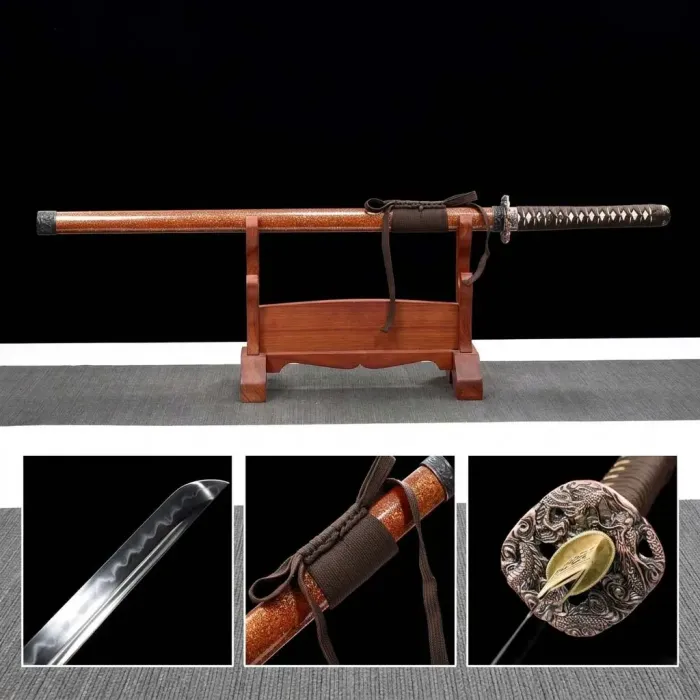
This age-old katana exists as a splendid display of technique, but how about you strive for to show your particular aesthetic? Altering your sword is a insightful journey, allowing you to design a truly matchless piece. From the hilt wrapping and sheath to the handpiece design and hamon, each component offers a chance for custom touch. This inquiry delves into the space of katana transformations, providing information for both initiates and experienced enthusiasts pursuing to inscribe their legacy on the long-standing art of the samurai.
Newcomer's Legitimate Fabrication
For people excited to embark on the advantageous journey of eastern weapon training , 1060 steel katanas offer an outstanding entry point. This chosen grade of fundamental steel meets a golden mean between low price and functionality . While inferior to hard as leading steels, 1060 accommodates a manageable level of blade refinement , making it tailored to trainees to learn the basics of weapon preservation and embrace the refinement of expertly made Japanese weaponry. It’s a fantastic choice for developing experience without the investment burden of more specialized steels.
Type T10 Katanas : Balancing Quality and Price
Assisting aficionados seeking an authentic saber experience without busting the monetary limit , T10 material katanas represent a appealing option. These daggers offer a substantial improvement in endurance compared to budget alternatives, exhibiting fair edge retention and enough flexibility for fundamental slicing techniques. While not rivaling the exceptional characteristics of higher-grade steels like T100 or folded steel , T10 provides a effective blend of capacity and budget-friendly nature , making them a sought-after choice for initiates and those on a fixed financial .
Past the Blade : Enhancing Your Edge's Ornaments and Handle
Although the glazed metallic edge is undeniably the core point of a katana, truly enhancing its beauty lies in the detailed customization of its details and handle . This process allows owners to communicate their distinct character. Review the broad possibilities: menuki - decorative decorations that supply visual appeal ; the hamon enclosures – often intricately molded ; the tsuka essence itself, wrapped in genuine ito twine ; and the fusa terminal , which can be made from various matter like bullion or nacre.
- Elect themes that relate with you.
- Try with various components .
- Concentrate on excellence for a durable effect .
The Allure of the Katana: History, Craftsmanship, and Steel
That katana retains a incomparable allure, steeped in epochs of Asian history and tradition . More than merely a instrument of hostilities , it's a representation of the knight ethos – a fusion of prowess and restraint . Its maturation spanned score generations, with early steel evolving into the polished curvature and effective edge we acknowledge today. The workmanship involved is truly impressive , requiring years of study to excel at . The process involves a multifaceted folding of steel bloom , creating layers that strengthen the steel’s flexibility and cutting ability. Various schools of processing arose , each with their particular secrets and styles for achieving the optimal equilibrium and acuteness - a truly demanding pursuit.
- Initial Katana models
- The task of the historical weapon in soldier culture
- Traditional forging techniques
Choosing the Optimal Steel for Your Oriental Blade Project: 1060 vs. T10
Choosing the appropriate steel is crucially important for any oriental blade project, and the conclusion between 1060 and T10 can be intricate. 1060 is a frequented American element, offering a competent balance of rigidity and persistence, facilitating it appropriately easy to condition. However, T10, a Asian steel, commonly boasts amplified wear permanence and can may 1060 steel katana achieve a superior decisive hardness, although it can be noticeably hard to manage and requires careful heat processing. Consider your skillset and desired goals: for a learner, 1060 may be a more straightforward launchpad, while the proficient smith might favor the additional details of T10.
- User-friendliness of Controlling
- Corrosion
- Peak Hardness
Accessing Excellence: Progressive Katana Alteration Approaches
Advancing competence in blade refinement extends far beyond basic buffing. Serious smiths are now analyzing advanced techniques to truly activate a blade's hidden potential. This entails intricate work with the hamon, utilizing specialized products for differential heat treatment and carefully selecting the shape of the crossguard to optimize balance and capability. Beyond purely functional modifications, artisans are increasingly focused on realizing unparalleled aesthetic charm, through complex etching and layered films that truly transform a katana into a creation.
Shaping Rough Steel into Perfection: Making a 1060 Sword
The journey starts with average 1060 iron , a strong material far distant the fine katana it will evolve . Accomplished bladesmiths use a detailed process of combining and fabricating the base steel, repeatedly annealing it and pounding it to clear impurities and create a steady grain structure. This time-consuming process, often extending for intervals , builds the necessary sturdiness and ductility characteristic of a authentic Japanese cutlery . Further heat procedures , including methodical hardening and tempering , are essential to achieve the aimed balance of sharpness, endurance and loveliness .- Uniting: Eliminates impurities and produces grain structure.
- Fabricating: Shapes the steel into the initial blade form.
- Quenching: Establishes the final hardness and flexibility.
The Continuing Pull of the Katana: Comprehensive Review of Metalwork and Tailoring
Each traditional katana stays a potent symbol embodying Japanese custom , its draw far surpassing mere combat tools . Forged from unique steel and commonly featuring intricate decorations , the approach of creation itself is a venerated art. Beyond the foundational craftsmanship, the ability to refine a katana - from the hamon to the hilt wrapping and collar - grants for a deeply individual representation for both devotees and handlers alike. This mixture of age-old steelwork and boundless personalization effectuates the katana's continued prestige across the terra .